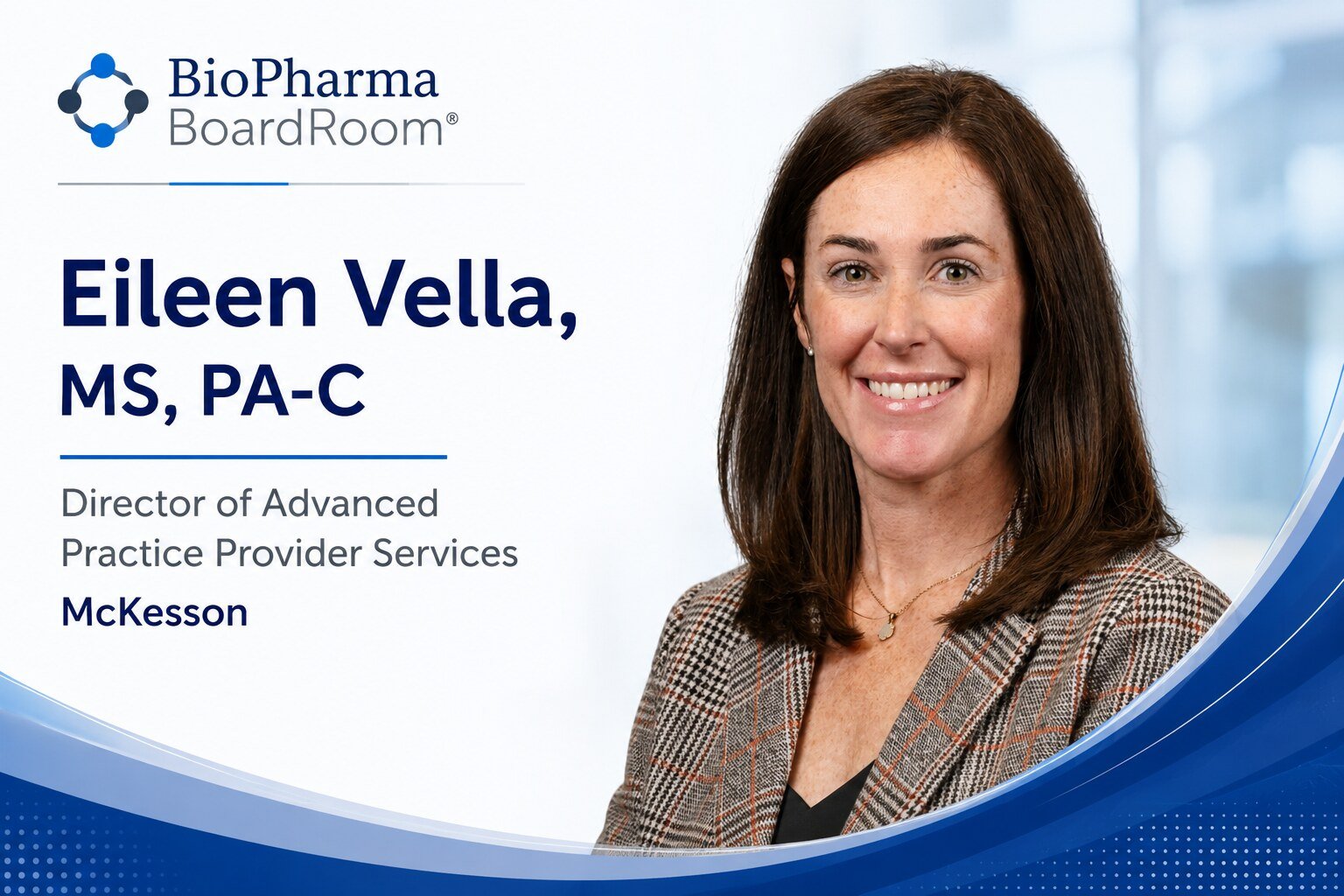
Eileen Vella explores how advanced practice providers are improving patient access, reducing wait times, and helping community oncology practices address growing workforce challenges through team-based care.
As oncology practices face increasing patient demand and looming workforce shortages, advanced practice providers (APPs) are becoming an essential part of delivering timely, high-quality cancer care. In this BioPharma Boardroom interview, Eileen Vella, MS, PA-C, Director of Advanced Practice Provider Services at McKesson, discusses new research demonstrating the impact of APP-led consult models in community oncology. She shares how these approaches can significantly reduce patient wait times, improve clinic efficiency, and enable physicians to focus on complex cancer cases, while highlighting the evolving role of APPs in building more sustainable, collaborative, and patient-centered oncology care teams.
Q: Your research examines advanced practice provider-led new consults in community oncology. What impact did APP-led models have on patient access and workflow efficiency?
- A: In our research at The US Oncology Network for our APP-led benign hematology consults, we looked at four different US Oncology practices. The key metrics that we analyzed were "time to first," which means the time that the patient had an appointment scheduled to the time that they came in for their visit and then we also examined APP productivity and the number of new cancer patients.
- In looking across our four practices, we saw a reduction in “time to first” by about 50%. For example, there was a practice where it took about 15 days for a cancer patient to be seen in clinic, and when implementing APP-led benign hematology consults, it was cut down to seven days. This was an opportunity for physicians to move these new consult benign hematology patients over to the APP schedule so that they can see new cancer patients in a more efficient and timely fashion.
Q: As oncology workforce shortages continue, how critical are APPs to maintaining timely cancer care delivery in community settings?
- A: Literature shows that we are headed towards a significant oncology workforce shortage, and APPs are really a key lever in improving access. Our benign hematology initiative is one of those examples, but even in the everyday role of the APP in community oncology, they can be utilized to see follow-ups, patients on treatment, symptom management, urgent care visits, and hospital discharges as well. It’s timely to think about the APP strategy in community oncology and taking a team-based care approach.
Q: What are the biggest misconceptions about the role of physician assistants and nurse practitioners in oncology care?
- A: Some of the biggest misconceptions are around their scope in which they can see patients. It does vary state by state, so that's certainly true but the focus for physician assistants and nurse practitioners is to see patients independently. We don't need to be seeing patients in a shared capacity, but, when the appropriate patients are identified, APPs can really be leveraged to see these patients independently and improve access to care.
Q: How can oncology practices better structure multidisciplinary collaboration between oncologists and APPs to improve patient outcomes?
- A: This is a great question. When we look at that multidisciplinary approach, it's about understanding the roles and expectations of the care team, what are the types of patients that should fall within the physician purview versus that of the APP, and then similarly, how can nursing, pharmacists, and medical assistants really augment and make the visit for the patient more collaborative and more efficient.
Our job at The US Oncology Network in supporting practices is to help identify those workflow challenges and then give strategies to improve them – it's about collaboration, communication and escalation.
Q: What policy or reimbursement changes would most help expand APP utilization in community oncology?
- A: Much is around the scope within our licensure and from a policy and an advocacy standpoint, ensuring that APPs are working at the top of their license and able to prescribe different therapies as well. That's really where our national organizations are focusing on and similarly, from a reimbursement standpoint, making sure that the visits that the APPs are seeing are reimbursed at the highest level as well.
###