12 March 2026 | Thursday | Interaction
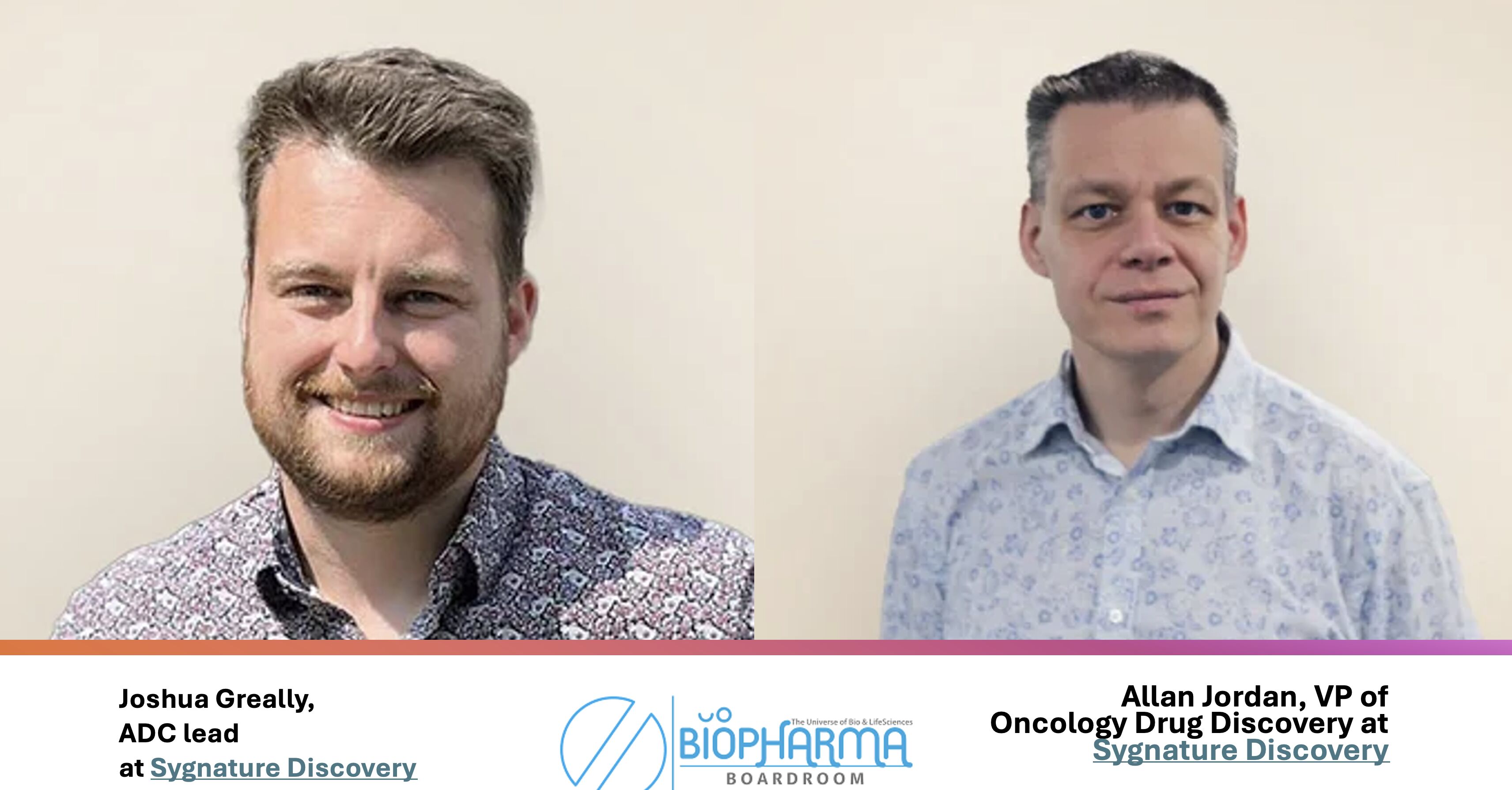
As the antibody–drug conjugate (ADC) landscape rapidly evolves, the industry is moving beyond traditional cytotoxic payloads and antibody-first development strategies toward more integrated, precision-engineered therapeutics. In a BioPharma Boardroom interaction, Allan Jordan, VP of Oncology Drug Discovery, and Joshua Greally, ADC Lead at Sygnature Discovery, share their perspectives on the scientific and strategic shifts redefining next-generation ADCs. From the concept of “selectivity squared” to the growing importance of linker innovation, novel payload discovery, and cross-disciplinary collaboration, they outline how the next wave of ADC development could deliver safer, more effective targeted cancer therapies.
The ADC field has evolved rapidly over the past five years. From your perspective, what defines a truly “next-generation” ADC today, and how is that definition shifting compared with first-wave conjugates?
Depending on who you talk to at World ADC, we seem to be now working on 4th, 5th or even 6th generation ADCs – that’s how many iterations we’ve seen in the field over the past four decades. Right now, the next generation ADCs are moving beyond just antibody discovery and development, with a sharper focus on linker and payload chemistry and properties to really move the needle on tolerability.
To date, almost all ADCs rely on just a few classes of non-selective, cytotoxic payloads, and had challenges with stability, resulting in systemic payload release and limited patient benefit. This has also led to ADCs being an ‘antibody first’ development approach, the has result in ADCs being thought of as an extension of the MAB field, yet the addition of a payload brings equivalent need for small molecule development often underrepresented. The next generation of ADCs will be the result of a more holistic development pathway in which chemists and antibody engineers work synergistically. This will produce truly target specific ADCs, leveraging novel payload targets and resulting in better tolerated and efficacious ADCs.
Manufacturing complexity and scalability remain persistent bottlenecks in ADC development. Where do you see the greatest operational constraints today, and what practical strategies can companies adopt to avoid delays as pipelines expand?
That’s somewhat outside the scope we operate within, but the move toward less toxic payloads will certainly help with the operational challenges of making multi-kilo quantities of highly toxic, non-selective warheads with significant harm potential to those working on their production.
Your panel will explore the migration away from non-selective payloads. What characteristics should developers prioritize when evaluating new payload classes, and how do you balance potency with safety and developability?
As we move forward, we are learning lessons from the precision oncology approaches, with highly targeted therapeutics which specifically interact with mutated drug targets present only in cancer cells and not in normal tissues. This drastically reduces the risk of on-target systemic toxicity and, when coupled with a cancer-specific antibody, gives rise to a dual specificity approach, which we call “selectivity squared”. So, safety and developability are facilitated as the payloads should be much less prone to illicit systemic toxicity. So, prioritization of on-target mechanism unique to the diseased cell state, with linkers which are more stable in systemic circulation, are good guidelines to work toward. And that all distils down to a properly optimised payload which is tuned through traditional design-make-test cycles toward the properties required for a competent ADC payload. The primary challenge with new payloads is finding them. As it stands, I don’t think we know what truly makes a good payload we tend to have a potency we believe is the right range yet, there are physiochemical and PK properties that remain elusive. Gaining insights into these is critical for the future of ADCs.
There is increasing interest in dual-payload and multifunctional ADCs. In your view, do these represent a meaningful therapeutic advance, or do they introduce additional risk in terms of toxicity, regulatory complexity, and manufacturability?
I think, to an extent, probably both! The development plan will be more complex, as we seek to ensure robust target engagement with multiple mechanistic pathways, contend with differing release kinetics and synthesise increasingly complex linker/payload combinations. There is an element of running before walking with the more complex modalities. Both bispecific and dual payload development significantly increase the mechanistic complexity of the ADC and therefore preclinical development needs to be more robust and the design needs to be well thought through both with payload selection and antigenic target combinations. As we outline in the section above, toxicity should reduce if the payloads are highly targeted to the diseased cell state and are not selected just as a generic payload or one targeted against a pathway involved in normal cell homeostasis. On the flip side, the ability to engage with parallel disease pathways helps to combat tumour heterogeneity, in the same way as we have attempted to do with other systemic targeted therapeutics, but with less need to dose-reduce the agents to gain tolerability. Or we can exploit genetic weaknesses in the cells to engineer synthetic lethality and use this to turbo-charge the effectiveness of our payloads.
ADC toxicity remains a central challenge, particularly as targets become more ambitious. How should developers approach early risk assessment to improve clinical success rates without slowing innovation
The choice of target carries, I think, the greatest risk. So, we can do a degree of that risk assessment right up front as we pick our targets. As we have mentioned already, ADC toxicity generally stems from either a) the systemic release of a non-specific and toxic payload or accumulation of ADC in off- target tissues. Almost all is attributed to the payload, if we want to move to less toxic ADCs then we must address the route of the problem and find more selective payloads specific to disease and which - if and when they do suffer from systemic break-down - are rapidly broken down further into non-toxic metabolites.
Looking ahead, what strategic shifts—whether in design, automation, supply chain resilience, or cross-disciplinary integration—will most influence the competitiveness of ADC programs over the next three to five years?
I think the path forward is clear. The markets, and the clinic, are saturated with payloads based on Topo1 inhibitors or MMAE/Auristatins. There simply isn’t room for even more of the same. We need a true paradigm shift if we are going to broaden the ADC scope and bring extra benefit to patients. That new approach demands a cross-discipline, de-siloed approach common in small molecule drug discovery but less common in ADC discovery and development. We’ve got lots of shared experiences in truly integrated, holistic and cross-disciplinary drug discovery – let’s shift the framework of ADC discovery and draw upon these learnings, to deliver truly novel, and truly beneficial, new therapeutics.



© 2026 Biopharma Boardroom. All Rights Reserved.