Biopharma Boardroom speaks with DaltonTx about using integrated models, experimental evidence and large-scale structural analysis to improve how antibody candidates are selected and progressed.
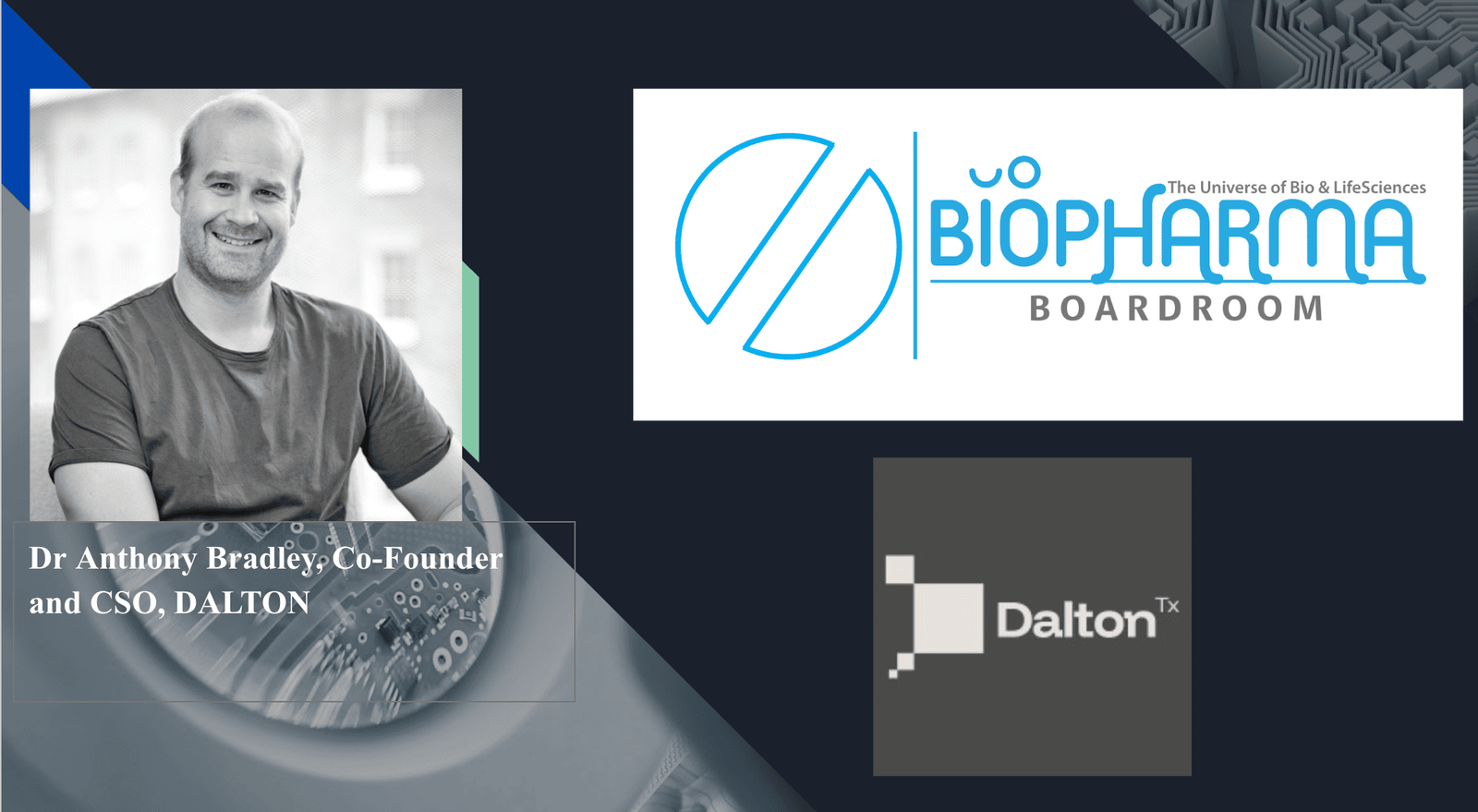
Biopharma Boardroom speaks with Dr Anthony Bradley, Co-Founder and Chief Scientific Officer at Dalton, about how the company is bringing antibody design, structure prediction, developability assessment and experimental evidence into a single workflow to improve candidate selection and drug discovery decisions.
Q. What unmet need in antibody discovery were you looking to address with these new capabilities, and where do you see the biggest inefficiencies in current discovery workflows?
Antibody discovery is not short of models, tools or generated sequences. The harder problem is deciding which candidates are genuinely worth progressing. Discovery workflows are still highly fragmented: sequence analysis, structure prediction, developability assessment and experimental data often sit in separate systems, with scientists left to connect the results manually.
That fragmentation makes it difficult to compare evidence consistently and understand why one candidate was prioritised over another. It also means that valuable knowledge is easily lost between experiments, meetings and project handovers.
We wanted to address that decision problem. Dalton brings the relevant data and computational approaches into a single place, where candidates can be assessed using complementary methods and the reasoning behind each decision is captured. The objective is not simply to generate more antibodies. It is to make discovery more systematic and evidence-led, so experimental resources are directed towards candidates with the strongest overall rationale for progression.
Q. Dalton brings antibody design, structure prediction and validation into a single workflow. What advantages does this integrated approach offer customers compared with using multiple specialised tools independently?
Individual tools can be excellent, but a collection of good tools does not automatically create a good discovery process. Each tool may use different inputs, assumptions and outputs, leaving scientists to move data between systems and reconcile conflicting results themselves.
Dalton provides a common framework in which design, structure prediction, developability assessment and experimental evidence can be considered together. The platform is model-agnostic, so the most appropriate approach can be used for each question and replaced as the science develops. The important point is that these models operate inside a consistent validation and decision-making workflow, rather than as isolated predictions.
This gives customers traceability across the campaign: which evidence supported a candidate, what trade-offs were made and why a molecule was progressed or rejected. It also allows learning to accumulate across design cycles. The advantage is therefore not simply convenience. It is a more coherent, reproducible and adaptable way to make scientific decisions.
Q. The platform can evaluate millions of antibody sequences within hours. How could this ability to operate at scale change the way biopharma companies identify, prioritise and progress candidates?
Scale changes the question from ‘which sequences can we analyse?’ to ‘which experiments are actually worth running?’ Dalton recently folded the 2.6 million paired sequences in the Observed Antibody Space (OAS) at a rate of 87,000 structures per hour. That makes it possible to examine an entire repertoire structurally rather than relying on a small, conveniently selected subset.
The real value, however, is not the number of sequences processed. At repertoire scale, companies can identify structurally diverse candidate families, detect promising low-enrichment binders that might otherwise be missed and avoid progressing many near-duplicate molecules. Candidates can then be prioritised across binding, structural fit, developability and other programme-specific requirements.
This should help teams preserve diversity early, identify risks sooner and make more informed choices before committing laboratory resources. In that sense, scale is not about generating a larger answer set. It is about obtaining a clearer view of the available design space and selecting a smaller, better-justified set of experiments.
Q. Dalton supports projects from hit identification and optimisation through to complex formats such as bispecifics. Which applications and customer groups do you expect to drive the strongest demand initially?
Initially, I expect the strongest demand to come from organisations that already generate substantial antibody data but need better ways to interpret and act on it. That includes biopharma companies, antibody discovery biotechs and CROs working with display or other high-throughput screening technologies.
The most immediate applications are likely to be hit selection, repertoire analysis and lead optimisation. In these areas, Dalton can help teams uncover structurally distinct candidates, balance affinity with developability and choose a more informative set of molecules for experimental testing. Species cross-reactivity and freedom-to-operate design are also practical problems where targeted computational design can reduce repeated cycles of screening.
Bispecifics and other complex formats are an important extension because the design problem is inherently multi-parameter. It is not enough for each component to bind independently. The overall molecule must have the right geometry, developability and functional behaviour. These are precisely the situations where integrating multiple models with experimental evidence becomes more valuable than applying individual tools in isolation.
Q. As AI tools become more widely available across antibody discovery, what will differentiate successful platforms, and how do you see DaltonTx positioning itself in an increasingly competitive market?
Access to an AI model will not be the differentiator. Models are becoming more available and will continue to improve, but producing a plausible sequence or structure is only one part of discovering a useful antibody.
Successful platforms will be differentiated by how well they connect models with proprietary data, experimental results and scientific judgement. They will also need to show where an answer came from, how reliable it is and whether it improves the next decision. In drug discovery, a strong benchmark result is not the same as project impact.
Dalton is the decision engine around those models. The platform is model-agnostic and designed to incorporate new computational methods as the field advances. More importantly, it captures the context behind each decision and continuously tests computational outputs against experimental evidence. Our ambition is not to win by claiming one model solves antibody discovery. It is to provide the infrastructure through which models, data and scientists work together, so every experimental cycle improves the next choice.
Q. Looking beyond this launch, where do you see the biggest opportunities to expand Dalton’s capabilities and its role across the wider drug discovery process?
The largest opportunity is to link antibody design more directly to function. Binding is necessary, but it is rarely the complete objective. The important questions are what the antibody does in the relevant biological system, how design choices affect that behaviour and which experiment will be most informative next.
We therefore see Dalton developing as a learning system across design, screening and functional validation. That includes learning across targets and campaigns, using active learning to select experiments and supporting increasingly complex formats in which geometry, developability and biological activity must be optimised together.
More broadly, the same principle applies across drug discovery. Dalton already supports both biologics and small molecules, allowing data, models and decisions to be connected across the process. Over time, this creates a form of scientific memory: what worked, what failed and why. The longer-term role of Dalton is not simply to run computational tools, but to help organisations build a discovery system in which knowledge and decision quality compound with every project.