09 September 2026 | Wednesday | Interaction
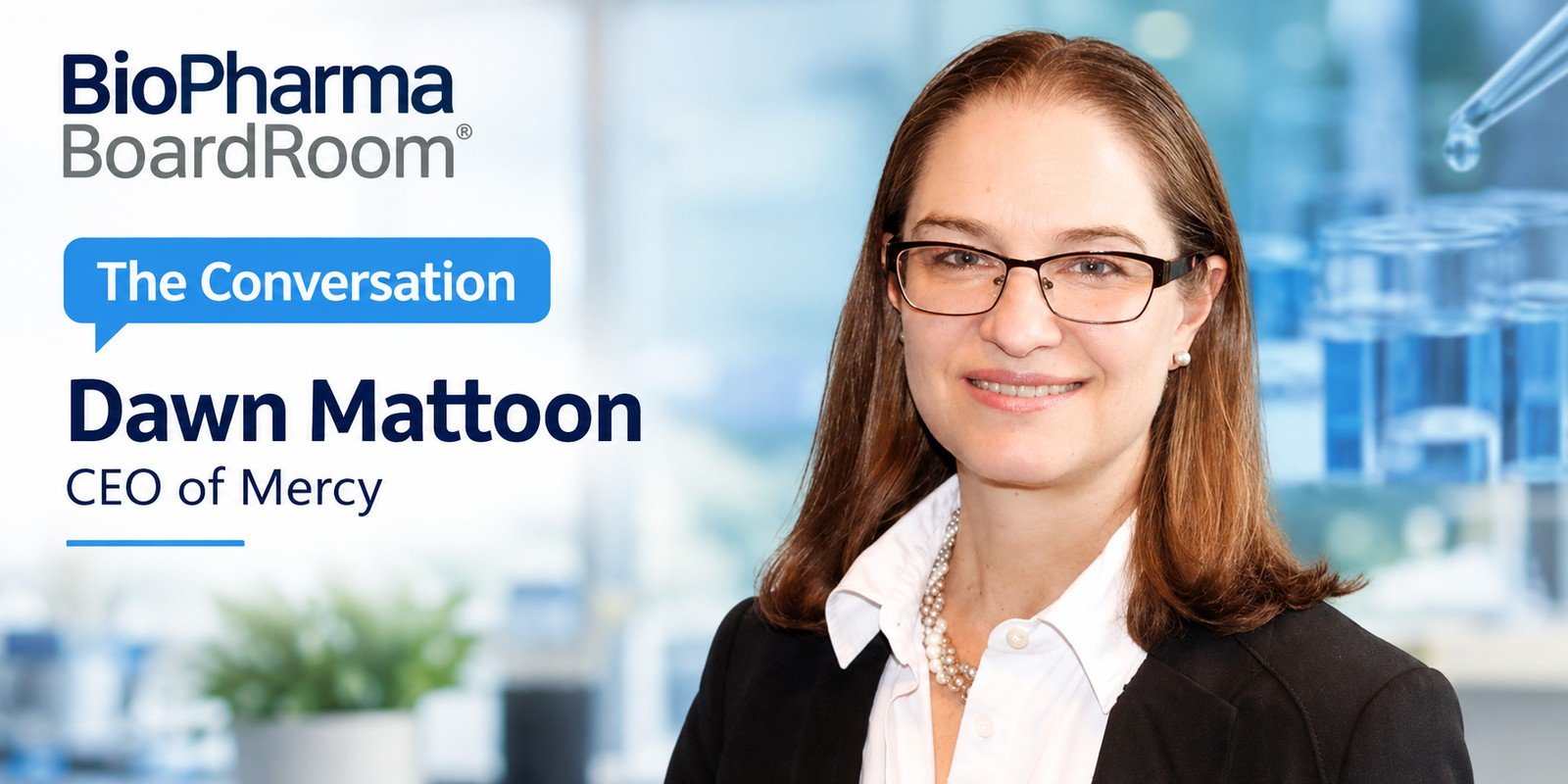
Early detection remains one of the biggest challenges in cancer care, particularly for ovarian cancer, where symptoms can be difficult to recognize and effective routine screening options remain limited. Mercy is addressing this gap through its Mercy Halo™ blood-based diagnostics platform, which analyzes tumor-associated proteins on extracellular vesicles and particles to identify signals of cancer that may be present at earlier stages of disease.
In this BioPharma Boardroom interview, Dawn Mattoon, CEO of Mercy, discusses the development and clinical validation of the company’s Evident Test, its expansion through an Early Access Program, and the significance of its FDA Breakthrough Device Designation. She also explores how advances in AI-powered imaging could complement blood-based screening, the company’s growing clinical and commercial infrastructure, and Mercy’s longer-term vision for extending its platform across multiple cancer indications.
What are the key challenges your organization is addressing, and how is your current approach helping overcome them?
Today’s diagnostic tools, including physical exams, imaging studies, and circulating tumor DNA-based tests, many cancers are invisible at early stages of disease, which is often when there’s the most hope for treatment and long-term survival. Our blood-based Mercy Halo™, diagnostics platform, which measures tumor-derived extracellular vesicles, is designed to detection of cancers including ovarian cancer and lung cancer at an earlier stage, with the aim of improving outcomes for patients.
In the U.S., roughly 80% of ovarian cancers are diagnosed at an advanced stage, when five-year survival drops sharply. Part of what makes this so difficult is structural: a standard pelvic exam usually can’t detect small ovarian tumors, and unlike some other cancers, there still is no currently available screening test accurate enough for routine ovarian cancer screening. Additionally, the vague symptoms associated with ovarian cancer like bloating, back pain, and changes in weight are things many postmenopausal women experience and may not connect to a risk that cancer is present.
That’s the challenge a screening test needs to address: identifying disease earlier in women who otherwise may not have a reason to suspect something is wrong, at a point when treatment is more likely to be effective. If we can support earlier detection, shifting diagnosis from stage 3 or 4, where the majority of cases are found today, to earlier stages, then five-year survival rates could run about 92% when caught while localized, versus about 31% once it has spread, according to National Cancer Institute SEER data.
Our approach starts with science. There is tremendous innovation happening in early cancer detection, but promising science must be validated rigorously before we can understand its true potential for patient impact. The Evident Test, our blood-based ovarian cancer screening test, uses the Mercy Halo™ technology platform and reflects years of development and clinical validation. Our goal is to advance Evident towards FDA approval and broad clinical adoption with the same scientific rigor that has guided the program from the beginning.
How are advances in technology, AI, or data analytics influencing your strategy and decision-making?
Technology is central to our strategy, but what matters most is whether it can address the biology of early-stage disease in a practical way. Unlike approaches that rely on next generation sequencing of circulating tumor DNA, which can be scarce in early-stage disease, Evident reads tumor-associated proteins on extracellular vesicles and particles, which are highly abundant even in the setting of early-stage disease.
Data is equally important because a promising technology is only as meaningful as the evidence behind it. We’ve been very deliberate about moving from early development into independent clinical validation and ultimately blinded studies in the populations where the test is intended to be used. Our lung program is a good example of that discipline in practice. We presented new data at ASCO this year using biospecimens from the National Lung Screening Trial, extending the same extracellular vesicle-based approach beyond ovarian cancer. In this study, our blood test identified a number of cancers that were missed when the radiologist interpreted the LDCT screening image. When the images were evaluated by an AI-interpretation tool, many of those cancers were flagged. We envision a future in which blood-based first line screening reflexes to imaging studies augmented with AI interpretation tools. This is emerging science and will be an important component of future validation studies.
What recent developments or milestones have been most significant for your organization, and what do they mean for customers or patients?
Mercy has expanded our real-world patient access this year. The Evident Test is now available through our Early Access Program with clinical partners. We started in Florida and are now expanding that program into Texas and Georgia. That expansion is giving us real insight from clinicians actually using the test. Evident has also received FDA Breakthrough Device Designation, which gives us regular, structured engagement with the Agency as we advance through the review of our Modular PMA submission.
This summer we completed a blinded clinical validation study evaluating the Evident Test’s performance in detecting pre-clinical ovarian cancer in postmenopausal women. The study gave us insights into how the test performs in detecting ovarian cancer in women being screened for the first time, and in women who had been screened annually. The study additionally allowed us to measure how much earlier the Evident Test detects ovarian cancer compared to existing modalities including the CA125 serum biomarker. The results were extraordinary, and we plan to present the complete dataset at a major clinical conference next year in parallel with its publication.
How are you adapting your operations and partnerships to meet the changing needs of the biopharma industry?
No company brings a new screening paradigm to patients on its own. It takes collaboration across clinical researchers, regulators, payers, advocacy organizations, and commercial partners. As we move toward commercialization, we’re focused on expanding and deepening those relationships while developing the internal capabilities needed to deliver The Evident Test portfolio at scale. It's a heavy and somewhat capital-intensive lift, but it's the right moment for it.
Operationally, that shows up in concrete ways. We brought on a Chief Commercial Officer to build and lead our market access, sales, and marketing functions. Our clinical laboratory has earned CLIA certification and CAP accreditation, ensuring the rigor and quality of lab operations that patients and clinicians should expect. On the regulatory front, Evident’s FDA Breakthrough Device Designation means we are in regular, structured engagement with the Agency as we move through review of our Modular PMA submission. Perhaps most importantly, by offering a simple blood test, we are working to make the early detection of cancer broadly accessible to patients no matter where they live, without the need to access specialized technology, or take time away from work or family.
What opportunities do you see emerging over the next 12–24 months, and where are you investing most heavily to capture them?
One important opportunity we’re evaluating is how our technology platform can be leveraged support a future multi-cancer strategy, while staying focused on ovarian cancer as our lead commercial priority. This year, Congress established a Medicare coverage pathway for FDA-approved multi-cancer tests, creating a framework for broad patient access for tests that pass the FDA’s rigorous evaluation.
Right now, our priority is fully validating and commercializing the Evident ovarian cancer test portfolio, starting with the test for screening average-risk postmenopausal women. We anticipate adding additional indications to the portfolio in the coming months, including a test designed to aid in the diagnosis of women presenting with signs or symptoms of ovarian cancer, and a test designed to aid in the surveillance of women at elevated genetic risk who have elected to delay guidelines-recommended surgery.
What is your vision for the company’s growth, and what will be the most important priorities in achieving that vision?
The team at Mercy has worked very intentionally to bring exceptional rigor and scientific integrity to our development and validation studies, and that has unlocked productive collaborations with leading clinical researchers. We’re well established among researchers. As we begin to commercialize the Evident Test portfolio, I am excited to bring that same level of rigor and scientific integrity to patients and providers. Earning the trust of clinicians, patients, and the broader healthcare community requires different kinds of conversations around new kinds of data. I am excited to see Mercy show up in those conversations I want us to do that the same way: boldly ambitious in our desire for broad patient impact, but always staying grounded in the scientific and clinical evidence.
At the center of that is staying patient-centric. It's easy to get pulled into the nuances of the data, or announcements from competitors, or the latest policy change or regulatory development. But if the way we represent ourselves, and our test portfolio doesn't resonate with the patients we're seeking to serve, none of the rest of it matters.
Our growth story is anchored in establishing our commercial and clinical impact in ovarian cancer first, where the unmet need is so critical. Our work in lung and other cancers is clearly showing that our technology platform is extensible, and as I look to the longer horizon I believe Mercy will come to be known as a platform powering earlier and more accessible detection across a plurality of diseases and indications.






© 2026 Biopharma Boardroom. All Rights Reserved.