17 September 2026 | Thursday | Interaction
As cell and gene therapies progress towards broader commercialisation, scientific innovation alone is no longer enough. The next generation of therapies must be designed from the outset with potency, manufacturability, scalability, analytical robustness and supply-chain resilience working together.
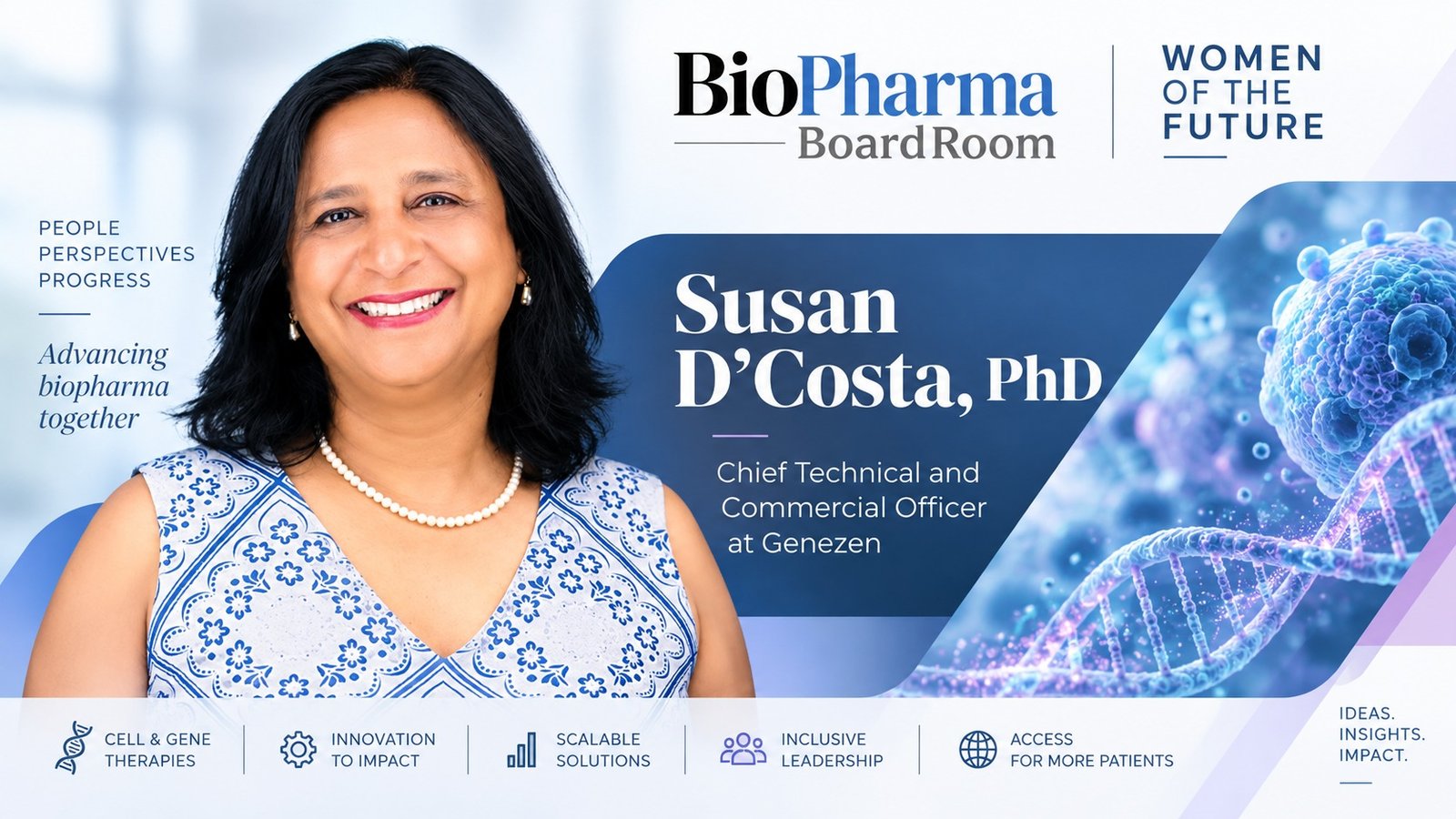
In this Women of the Future conversation with BioPharma BoardRoom, Susan D’Costa, PhD, Chief Technical and Commercial Officer at Genezen, discusses the scientific and manufacturing challenges still limiting commercial scale, the potential of AI and data sharing to improve development, and why CMC must begin alongside discovery rather than follow it. She also reflects on women in scientific leadership and the importance of creating pathways that enable more women to take their seat at the table and progress into senior leadership.
As cell and gene therapies move from clinical development toward broader commercialisation, what are the key scientific challenges that the industry still needs to address?
As more cell and gene therapies advance toward commercialization, our learning continues to develop from a growing body of clinical and manufacturing experience. The opportunity is to create a stronger feedback loop between what we see in the clinic and how we design the next generation of therapies.
Deepening our understanding of vector biology and optimizing payload design while addressing persistent chemistry, manufacturing and controls (CMC) challenges surrounding impurities, dose and immune response is essential to build better products and expand delivery opportunities. As new capsids and serotypes are engineered and clinically validated, our focus should be on building manufacturable and scalable processes with an eye toward platform processes and consistency.
Manufacturing processes are complex, produce low yields and require substantial investment in critical raw and starting materials. Simplifying the supply chain for these materials, single-use consumables and final product storage is essential as more products reach commercialization.
Analytical development remains a key challenge, including developing standardized methods that can be harmonized across multiple constructs. Validating state-of-the-art, sensitive, robust and QC-friendly methods will drive product quality and minimize adverse safety events in the clinic and beyond.
Ultimately, the field needs simpler, more robust and more streamlined processes that can support broader commercialization.
How are advances in cell and gene therapy platforms, vector technologies and manufacturing approaches changing the way developers think about the development of next-generation therapies?
Developers are taking a much more integrated view of advanced therapies. It is no longer enough to create a vector that works biologically. Potency, delivery, manufacturability, scalability and consistency all have to be considered together.
Investment should be focused on building better tools for starting materials, reagents for productivity and technologies for purification to drive better productivity and recovery with higher potencies and stability.
Greater potency could allow us to achieve the desired therapeutic effect with far less vector, reducing manufacturing burden and safety challenges associated with higher doses in the clinic. Advances in vector engineering are also creating opportunities for systemic delivery and reaching historically difficult targets, including across the blood-brain barrier, all achieved at much lower doses.
The key is to incorporate what we have learned from existing programs earlier, so next-generation therapies are designed with scalability and consistency in mind from the outset.
What do you see as the biggest opportunities for scientific and manufacturing innovation to improve the scalability, consistency and accessibility of cell and gene therapies?
One of the biggest opportunities is to become better at learning collectively as an industry. Greater data sharing, combined with AI and computational tools, could help us model aspects of drug development, delivery and manufacturability before committing significant resources to wet-lab experimentation.
We also need to continue progressing toward more economical manufacturing models. Accessibility will remain challenging if therapies are exceptionally complex and expensive to manufacture at scale. Cutting-edge technology and advanced therapies should be accessible to everyone, not just the developed world, but today the cost of these therapies continues to make it inaccessible to low- and middle-income countries.
Supply chain resilience should always be part of the cell and gene therapy conversation. Transportation, storage, raw materials and single-use consumables can all introduce their own risks. Building qualified alternatives and more resilient supply networks will become increasingly important as these therapies move toward broader commercialization.
As therapeutic modalities become increasingly complex, how important is early collaboration between scientists, developers and manufacturing partners in overcoming development and translation challenges?
It is essential as CMC cannot begin after discovery. Quality-by-design and manufacturability need to be considered as early as possible. The most successful therapies are those that start with CMC at the outset, not as an afterthought. It builds for realistic capital deployment, attainable timelines and quality products with a faster, robust road to commercialization.
Ensuring that CMC is not an afterthought requires closer collaboration between discovery, process development, manufacturing and analytical teams, as well as scaled-down models that allow meaningful CMC work to begin earlier without the resources of a full manufacturing process. Using the same manufacturing partner from as early in discovery as possible drives more meaningful conclusions from discovery experiments to toxicology studies and first-in-human results.
Analytics are especially critical as you cannot fully understand or control a process without the right analytical tools. Bringing analytical strategy forward helps teams make better development decisions earlier and ultimately build more robust, scalable processes.
What has your experience as a woman in scientific leadership taught you about building teams, encouraging innovation and navigating the path to senior leadership in the life sciences?
One of the things I feel most strongly about is raising other women up during my own career development. Leadership should be inclusive, and I believe we have a responsibility to create opportunities for the next generation of scientists and leaders.
I also believe in creating an environment where people are encouraged to put ideas on the table. Drug development is not a democracy. We ultimately have to make decisions based on the science, the data and what is best for patients, but innovation depends on diversity of thought and a willingness to challenge assumptions.
For women in particular, there is also something to be said for having the courage of one’s convictions. My advice is to take the seat at the table, share the idea and ask the question.
I sometimes borrow a line from the movie Luca: “Silenzio, Bruno!” There will always be a voice telling you why you should not speak up or take the opportunity. Part of becoming a leader is learning when to quiet that voice.
What changes would you like to see across the life sciences industry to create stronger opportunities for women scientists to progress into senior scientific and executive leadership roles?
We see strong representation of women at the early stages of scientific careers, but that representation declines as you move into senior scientific and executive leadership. We need to look more closely at where and why that attrition occurs.
For many women, the years of greatest career advancement overlap with the years when they may also be starting and raising families. The industry needs more flexible ways to keep talented scientists engaged during that period, whether through part-time roles, technical writing, regulatory support or other opportunities that preserve their connection to the science and allow them to continue building expertise while ensuring they can still be nurturers.
We also need to make it easier for women to return after taking time away without permanently limiting their leadership potential. If we want more women at the top, we have to build better pathways that keep them in the pipeline along the way.



© 2026 Biopharma Boardroom. All Rights Reserved.