15 October 2026 | Thursday | Interview
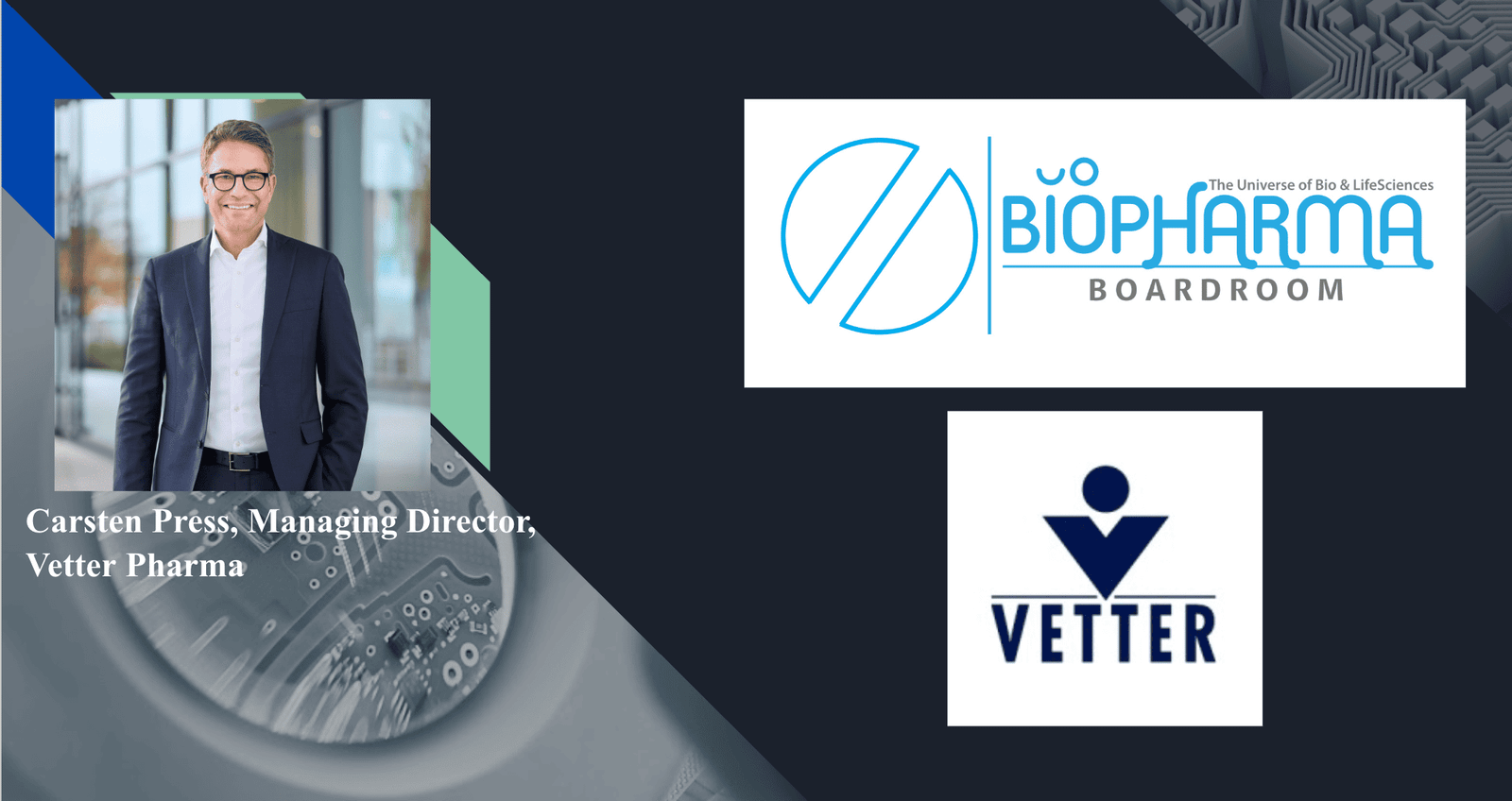
Biopharma Boardroom speaks with Carsten Press, Managing Director at Vetter Pharma, about the company’s expansion of commercial filling capacity, growing demand for pre-sterilised syringes, investments in automation and supply resilience, and the role of its planned Saarlouis site in supporting future injectable therapies.
Q. Vetter is adding ten more commercial filling lines across its global network. What is driving the need for this additional capacity from pharma and biotech customers?
Several market developments are contributing to the need for more aseptic filling capacity. Demand for injectable therapies continues to grow across a broad range of therapeutic areas, driven by advances in biologics and increasingly targeted treatments. Many of these products require sensitive handling processes, specialized aseptic manufacturing expertise, and a high degree of technical and operational reliability.
However, the need is not solely quantitative. Customers are also managing greater technical and regulatory complexity. The characteristics of molecules, container formats, administration routes, and commercialization strategies create varying manufacturing requirements. We also see that many pharmaceutical and biotech companies are focusing more on their core competencies in research and development. For further processing steps, such as aseptic filling, they rely on specialized outsourcing partners with extensive knowledge, in order to maintain high-quality, compliant production. Therefore, pharmaceutical and biotech companies need access to capacity and capabilities that can accommodate diverse products and stages of their lifecycle.
Long development timelines are another important consideration. Several years may pass between the early clinical development and the commercial launch of a drug product, and not every molecule will reach the market. At the same time, suitable commercial capacity cannot be created at short notice. Fill-and-finish CDMOs therefore must make investment decisions amid uncertainty, balancing current customer requirements with expectations about product pipelines and market demand.
Another aspect, many pharmaceutical and biotech companies are increasingly focusing on their core competencies and relying on specialized partners for aseptic manufacturing. Building and operating commercial fill-finish capacity requires significant investment, technical expertise, and long-term commitment. As product portfolios become more diverse and manufacturing requirements more sophisticated, the need for experienced partners that can provide both manufacturing capacity and supporting services throughout the product lifecycle continues to grow.
Our additional filling lines are intended to provide more options for supporting both established partner programs and potential new customers. The filling lines will be implemented at existing sites as well as at our new commercial site in Saarlouis. This approach combines near-term additions within established operations with a longer-term greenfield development.
At the same time, we are strengthening our clinical manufacturing network through our activities in Rankweil, Austria and Skokie, Illinois; and the current construction of our new US clinical facility in Des Plaines. These efforts support customers during early stages of developing innovative therapies and facilitate the transition from clinical development to commercial supply.
The strategic rationale is therefore broader than simply increasing output. It is about preparing for a market in which injectable products are growing in number and diversity, while customer requests are becoming more individualized and technically demanding.
The long-term value of the investment is rooted in its close alignment with anticipated customer demand, product pipelines, and future manufacturing challenges. Customers will benefit from having access to appropriate capacity, relevant expertise, and reliable support as their products progress toward commercial supply.
Q. The first new line for pre-sterilised syringes is already operational. What types of customer demand are you seeing for syringe-based manufacturing, and how important is this area to Vetter's growth?
Vetter has a long history and a strong track record in syringe filling. Traditionally, a large portion of our production volume consisted of bulk syringe processing, and this expertise remains an important part of our offerings. However, customer requirements, primary packaging technologies, and drug delivery systems have evolved.
One of the most significant developments is the growing adoption of ready-to-use, or RTU, containers. Historically, RTU platforms were primarily used for pre-sterilized syringes. Today, however, continued advances in container technology and the availability of additional formats are broadening their application across the injectable product life cycle. RTU technologies can support greater automation, reduce process steps at the filling site, and provide additional manufacturing flexibility.
Our investment strategy reflects this industry development. We systematically expanded our RTU capabilities while building on our established syringe expertise. Our current filling capabilities for bulk syringes exceed those for pre-sterilized syringes. Following the expansion, this balance will shift towards RTU manufacturing lines. Most of the new lines are designed to process pre-sterilized syringes. Some are combination lines that can process both pre-sterilized syringes and vials.
These changes represent a significant evolution of our capabilities and demonstrate the importance of syringe-based manufacturing to Vetter’s future growth. It enables us to respond to the growing demand for pre-sterilized systems while retaining bulk capabilities for products that require them.
Ultimately, our investment in commercial manufacturing combines Vetter's longstanding syringe expertise with growing RTU technology. It will provide customers with access to a broader range of manufacturing options, as well as the necessary capacity, expertise, and support as their products progress toward commercial supply.
Q. You are taking a phased approach to expanding capacity across existing sites and the planned Saarlouis facility. How does this approach help Vetter respond to changing customer needs while keeping production flexible?
Our phased approach allows for an expansion of capacity in a responsive, manageable, and sustainable way. The goal is to make additional resources available progressively while maintaining reliable supply, high quality standards, and robust performance in ongoing operations.
Adding filling lines at existing sites and establishing a new production facility requires much more than just construction and equipment. Each step involves supporting infrastructure, technology implementation, process qualification, and the recruitment and training of teams. Phasing the program enables Vetter to allocate these financial, technical, and human resources carefully without compromising existing customer commitments.
Expansion at established sites builds on proven structures and experienced teams, allowing production resources to become available earlier than if growth depended entirely on completing a new facility. Meanwhile, the Saarlouis greenfield project will expand our manufacturing network and create additional options for future product pipeline.
A phased approach also creates opportunities to learn and adjust along the way. Manufacturing technologies, regulatory and customer expectations continue to evolve. Experience gained from designing, qualifying, and operating earlier lines can inform subsequent expansion steps and help optimize processes, technologies, and interfaces.
This is particularly relevant for the Saarlouis site in Germany and the Des Plaines site in the US. We are evaluating which established processes and standards should be transferred to the new facilities, as well as where the greenfield environment creates opportunities to rethink workflows and introduce more efficient approches. The objective is to combine proven quality and manufacturing standards with an operational setup designed for future demand.
A phased expansion allows us to align capacity additions more closely with evolving customer timelines, product pipelines, and technology requirements. Rather than committing all resources at once, we can progressively introduce new capabilities and adjust future expansion steps as market conditions develop.
Q. Beyond filling capacity, Vetter is also investing in compounding, storage, inspection, automation and digitalisation. How are these investments changing the way you support customers across the drug development and manufacturing process?
Pharma and biotech companies increasingly look beyond filling capacity alone. Expanding filling resources is only effective if the surrounding processes can support the products and volumes involved. Aseptic manufacturing therefore depends on a connected system that includes material handling, compounding, filling, inspection, analytical testing, storage, assembly, packaging, quality management, and logistics.
Vetter's investments reflect this broader perspective. Compounding is essential for preparing and handling drug products before aseptic filling, especially for innovative molecules with sensitive formulations or specific processing requirements. Visual inspection is another essential part of the process. At Vetter, all filled units undergo either manual or automated visual inspection, mainly depending on product characteristics and batch size. As production volumes grow, investments in upstream and downstream processes, such as compounding, inspection, and storage infrastructure, help maintain balanced, scalable, and reliable operations.
Automation and digitalization connect and enhance these individual manufacturing steps. Advanced technologies can strengthen consistency, process control, efficiency, and transparency, while supporting data-based decisions and continuous improvement. Technology investments take many forms. One example is Vetter's proprietary cleanroom technology, V-CRT®, which combines the proven principles of isolator and RABS technologies. As product portfolios become more diverse and manufacturing requirements become more individualized, innovative technologies help maintain high-quality standards across a broad range of products and production scenarios. However, technology only creates value when it is applied appropriately, supported by robust processes, and operated by experienced personnel.
Our objective is not merely to automate processes or generate more data, but rather to apply technology to make better decisions and deliver reliable results. Ultimately, our current investment not just create a larger manufacturing environment but also a more integrated one that consistently and efficiently supports complex injectable products.
Q. Supply security has become a major concern for pharmaceutical companies in recent years. How are Vetter's investments helping customers build more reliable and resilient supply chains?
Supply security and supply chain resilience have become defining priorities for the pharmaceutical industry, as logistical delays can affect manufacturing readiness, market supply, and ultimately patient access to medicines. In recent years, global events, transportation disruptions, and geopolitical developments have demonstrated their ability to influence the availability of materials and the reliability of supply networks.
Every drug product relies on a complex, highly regulated supply chain involving active ingredients, primary packaging components, validated suppliers, production schedules, storage requirements, transportation routes, regulatory expectations, and customer commitments. Managing these interconnected elements becomes increasingly important as therapies and supply networks grow more complex.
Infrastructure improvement is part of Vetter's response. To support the growing demand for temperature-sensitive products, we are expanding our pharmaceutical warehouse in Ravensburg with a particular focus on cold-storage capabilities. We have also optimized short-term storage arrangements at our production facilities.
However, infrastructure alone does not create resilience. In fact, a high level of inventory can reduce flexibility if it is not aligned with forecast, shelf life, and production plans. Therefore, effective supply-chain management requires visibility into forecasts, inventory levels, material availability, delivery dates, and critical dependencies.
Close communication and established processes with customers are central. As a CDMO, we need to understand customer forecasts, expected market demand, and potential changes in order to adjust our inhouse planning and purchasing accordingly. Relationships with suppliers are equally important because specialized materials and container systems often have long lead times and limited alternatives.
From a customer's perspective, dependable commitments, early visibility of risks, and transparency regarding inventory and delivery dates are mandatory. Should disruptions occur, they need feasible recovery scenarios rather than explanations alone. This requires clear ownership and close collaboration between purchasing, production, logistics, quality, and customer-facing teams.
Our objective is to connect physical infrastructure with visibility and partnership to provide reliable storage and global logistics services. We support these services with transparent planning and early risk management to strengthen supply continuity and provide customers with greater confidence in the reliable delivery of critical injectable medicines to patients.
Q. Looking ahead to 2031 and the planned Saarlouis site, what role do you expect the expanded manufacturing network to play in Vetter's long-term strategy and in supporting the next generation of medicines?
Although the market is becoming more diverse and technically complex, the long-term outlook for injectable medicines remains positive. We see a broad pipeline of innovative molecules, such as monoclonal antibodies, peptides, and oligonucleotides. Internal market analyses and wider industry trends indicate that these modalities will remain important components of future pharmaceutical pipelines. At the same time, future medicines will likely be accompanied by continued advances in drug delivery technologies and patient-centric treatment approaches. Pharmaceutical companies increasingly seek solutions that improve ease of administration, support adherence, and enhance the overall patient experience.
These developments create opportunities as well as new manufacturing requirements. Innovative biologics can be highly sensitive to process conditions and may require specialized handling, container systems, or delivery technologies. At the same time, treatments are becoming more targeted, often resulting in smaller, more product-specific scenarios than traditional blockbuster products.
Pharmaceutical timelines make long-term planning particularly important. Development and approval can take several years, and clinical outcomes remain uncertain. The capacity and capabilities required for a future commercial product must therefore be considered well before approval or market launch. This long-term perspective is central to our strategy.
In this context, our planned commercial site in Saarlouis is a significant investment in future manufacturing capabilities. The site is under development and is expected to begin operations in 2031. In the first expansion phase, Vetter will build a 50,000 sqm manufacturing site, along with production-related facilities including laboratories and warehouses. Initially, three state-of-the-art cleanrooms are planned for the aseptic production of innovative and complex drug products: two for filling pre-sterilized syringes and one for filling vials. Its contribution should be viewed as part of the broader Vetter network rather than in isolation. The strategic value lies in combining clinical and commercial capabilities, supporting services, and geographic options.
Both pharmaceutical companies and their manufacturing partners are recognizing the growing importance of sustainability. When evaluating long-term partnerships, customers are placing greater emphasis on resource efficiency, energy consumption, emissions transparency, and responsible supply-chain management. For manufacturing organizations, sustainability initiatives often align with operational objectives, including reducing waste, improving efficiency, optimizing material usage, and managing energy consumption. As Vetter expands its global manufacturing network, it will continue to incorporate sustainability alongside quality, operational reliability, and patient safety considerations.
The purpose of the expanded network is not simply to produce more units. Rather, it is to provide the technical breadth, scalability, and long-term reliability needed to support increasingly sophisticated medicines as they progress from development to commercial supply. We believe our holistic expansion approach will bring additional value for our customers.




© 2026 Biopharma Boardroom. All Rights Reserved.