01 June 2026 | Monday | Interview
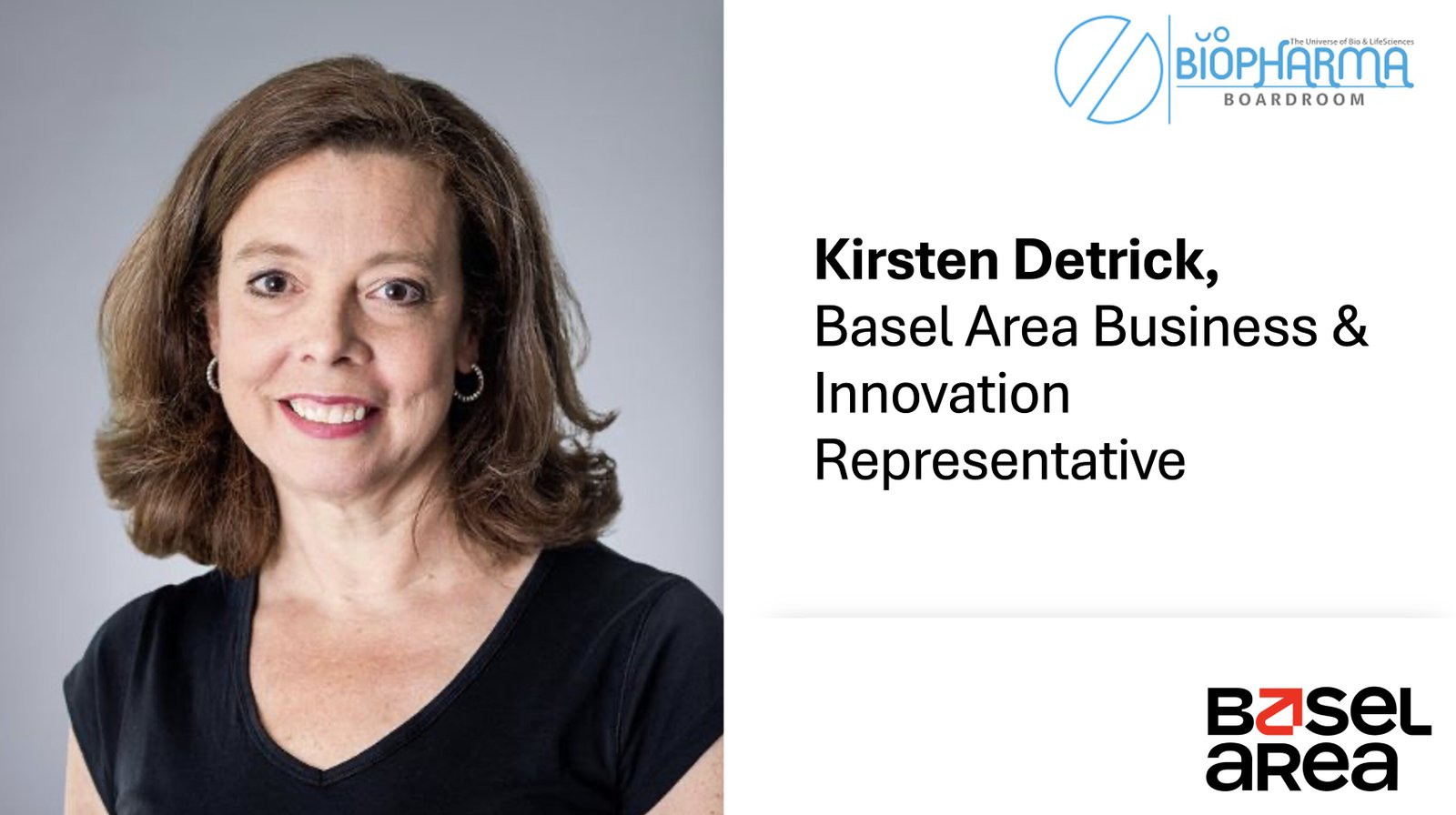
As biotech companies navigate increasingly complex pathways from scientific discovery to commercial success, the importance of location, expertise, and ecosystem has never been greater. In this exclusive conversation with BioPharma BoardRoom, Kirsten Detrick shares insights into why the Basel Area continues to attract global life sciences leaders, how U.S. biotechs can successfully approach European expansion, and the commercialization trends that will define the next generation of oncology and precision medicine innovation. From market access and reimbursement challenges to AI-driven commercialization strategies, Detrick outlines the critical factors shaping biotech growth and patient access worldwide.
Basel has long been recognized as one of the world’s leading life sciences ecosystems. What differentiates the Basel Area Life Sciences Supercluster from other global biotech hubs, particularly in oncology innovation and commercialization?
Answer: The Basel Area Life Sciences Supercluster is distinguished by its exceptional concentration of global commercialization expertise — particularly in oncology. The region is home to leaders with decades of experience bringing complex cancer therapies from clinical development to successful global launch. Collectively, these experts bring deep expertise in global marketing and commercialization strategy, market access, pricing and reimbursement, medical affairs, and evidence generation, gained through multiple oncology product launches.
That strength is especially important in today’s oncology environment, where success depends not only on scientific innovation, but also on the ability to navigate biomarker-driven treatment approaches, companion diagnostics, and increasingly complex global payer and HTA requirements — capabilities that are deeply embedded throughout the Basel ecosystem.
This unique environment is anchored by global industry leaders such as Novartis and Roche, both of which derive approximately one-third of their global revenues from oncology. Surrounding these organizations is a robust network of innovative biotech companies, specialized oncology firms, and entrepreneurial talent drawn to the region’s deep expertise and collaborative environment.
Collectively, professionals across the Basel region have played central roles in the development and global commercialization of multiple blockbuster cancer therapies while continuing to advance next-generation approaches in immuno-oncology, bispecific antibodies, radioligand therapies, cell and gene therapies, and antibody-drug conjugates.
Having held leadership roles across major multinational pharmaceutical companies, what are the biggest strategic mistakes U.S. biotech companies make when attempting to expand into European markets?
Answer: One of the biggest strategic mistakes U.S. biotech companies make when expanding into Europe is treating the decision as primarily geographic or administrative rather than a long-term strategic capability build.
Companies often rely too heavily on the familiarity of one or two employees with a particular country or city, rather than conducting a broad assessment of multiple locations and their relative strengths in talent, infrastructure, commercialization expertise, connectivity, and scalability.
Another common mistake is choosing a location based on proximity - to a manufacturing site, a regulatory agency or even a specific transportation hub. The unstated assumption is that proximity is more important than access to experienced talent and a strong life sciences ecosystem, matters far more over the long term.
Similarly, some companies hire a Head of Europe and then build the organization around where that person already lives, rather than selecting the location best aligned with the company’s strategic and commercial needs.
Finally, many companies focus too heavily on short-term cost rather than long-term value creation. The most successful European expansions are typically built in locations that provide deep drug development and commercialization expertise, operational infrastructure, and access to the breadth of experienced, cross-functional life sciences talent that is vital to successful drug launches and long-term company growth.
How do pricing, reimbursement, and market access dynamics in Europe fundamentally differ from those in the U.S., and what should emerging biotech companies understand early in their commercialization planning?
Answer: One of the biggest differences between the U.S. and Europe is that European pricing and reimbursement negotiations are often far more centralized and “all-or-nothing” in nature. In many European countries, a single government payer or health authority plays a dominant role in determining whether a therapy will be reimbursed and at what price. A negative reimbursement decision can therefore significantly limit commercial access within an entire country. Just as importantly, although the EU operates as a single regulatory framework, it is not a single commercial market; each country has distinct reimbursement systems and evidentiary expectations requiring localized market access strategies.
By contrast, the U.S. system is more fragmented across multiple commercial and government payers. While U.S. payers also increasingly demand strong health economics and outcomes research (HEOR), real-world evidence, and comparative value analyses, companies still have opportunities to negotiate across multiple payer organizations and channels.
Emerging biotech companies need to understand early that European success depends not only on regulatory approval, but also on building a compelling value proposition for health technology assessment (HTA) bodies and national payers. Clinical development decisions — including endpoint selection, comparator choice, and evidence-generation strategy — can have major downstream implications for reimbursement outcomes. This is why many successful companies increasingly co-locate cross-functional launch teams in deeply experienced ecosystems such as Basel, which is home to nearly 35,000 biopharma professionals spanning virtually every launch-critical function, including one of Europe’s deepest concentrations of commercial oncology talent.
As oncology innovation becomes increasingly globalized, how important is cross-border collaboration between biotech companies, regulators, investors, and healthcare systems in accelerating patient access to new therapies?
Answer: Cross-border collaboration has become essential to accelerating oncology innovation and patient access. Modern cancer therapies are too scientifically complex, capital-intensive, and operationally demanding to be developed efficiently within isolated national systems.
Today, successful oncology development depends on global clinical trial networks, multinational regulatory coordination, cross-border investment, and collaboration among biotech companies, healthcare systems, academic institutions, and diagnostic partners. This is especially true in areas such as precision medicine, cell and gene therapy, radioligand therapy, and biomarker-driven oncology.
Cross-border collaboration is also increasingly important for commercialization and reimbursement. Companies that engage early with regulators, health technology assessment bodies, payers, and healthcare systems across multiple countries are often better positioned to accelerate patient access.
This is one reason why highly interconnected ecosystems such as Basel are strategically important. Located at the intersection of Switzerland, Germany, and France, the region has built a deeply international life sciences environment where scientific, regulatory, commercial, and financial expertise interact across borders every day.
Many emerging biotech companies face growing pressure to demonstrate both clinical value and economic sustainability. How are commercialization expectations evolving for smaller and mid-sized innovators in today’s market environment?
Answer: Commercialization expectations for smaller and mid-sized biotech companies have evolved dramatically over the past decade. Investors, partners, and healthcare systems now expect companies to demonstrate not only strong clinical science, but also a credible path to reimbursement, commercial execution, and long-term value creation — even if the ultimate strategy is acquisition.
In oncology especially, it is no longer sufficient to generate efficacy data that simply achieves regulatory approval. The realities of launching into highly centralized payer systems require companies to think much earlier about patient selection, biomarker strategy, pricing and reimbursement, real-world evidence generation, manufacturing scalability, and country-by-country market access. As a result, the commercial “end game” increasingly shapes development strategy from the earliest stages of a company’s lifecycle.
At the same time, capital markets have become far more disciplined, favoring companies with differentiated value propositions, capital-efficient development plans, and realistic commercialization strategies. This is one reason why established life sciences ecosystems such as Basel continue to attract growth-stage biotech companies seeking access to experienced commercialization, regulatory, medical affairs, and market access talent.
Looking ahead, what trends do you believe will most significantly shape the future of biotech commercialization and global market expansion over the next five years?
Answer: Over the next five years, I believe several trends will fundamentally reshape biotech commercialization and global expansion.
First, commercialization strategy will move much earlier in the development process. Companies will increasingly need to integrate pricing, reimbursement, health economics, biomarker strategy, and real-world evidence generation into clinical development well before regulatory approval.
Second, artificial intelligence will increasingly transform both drug development and commercialization. AI-driven analytics will improve patient identification, trial design, evidence generation, forecasting, and physician engagement, while helping companies integrate increasingly complex clinical, diagnostic, and real-world datasets into faster and more informed commercial decision-making.
Third, oncology and rare disease commercialization will become increasingly precision-driven. Biomarker-defined populations, companion diagnostics, and highly targeted therapies will require much closer integration among diagnostics, medical affairs, regulatory, and commercial teams.
Finally, global market access pressures will continue to intensify. Governments and health technology assessment bodies will place greater emphasis on comparative value, outcomes, and economic sustainability, particularly for high-cost therapies such as cell and gene therapies, radioligand treatments, and complex biologics. At the same time, growing discussion around international reference pricing and “most favored nation” pricing concepts could further connect pricing decisions across major global markets, increasing the strategic importance of launch sequencing and global pricing strategy.
As commercialization grows more complex, companies will place even greater value on deeply integrated life sciences ecosystems such as Basel that provide dense concentrations of experienced talent across commercialization, regulatory, market access, and medical affairs functions.



© 2026 Biopharma Boardroom. All Rights Reserved.